Why Your Robot Still Can't Fold Laundry
Introduction
There has been significant attention on agents, with recent news like Opus 4.6 crushing the task-completion time horizon from METR, Peter Steinberger joining OpenAI to drive the next generation of personal agents,), or all the fear mongering (or optimism depending on who you ask) in the software development industry.
While the current frontier labs are working towards cognitive superintelligence, there are also many efforts in the background working on physical intelligence.
Robotics as we know it involves building a specialized machine that is really good at doing one task. An obvious example is a welder at an auto manufacturing plant. It does a really good job, and it is significantly more efficient than a human, but that is the only thing that robot will ever be able to do.
Similarly, we’ve previously had software that has one main function. But now with LLMs and agents, intelligence is more broadly applicable and adaptive to its environment.
Physical AI is also going to have its big “GPT-3” moment, but why are we not there yet?
The Problem
Data is the bottleneck. It’s not the hardware, and it’s certainly not the algorithms.
Every major breakthrough we have experienced has been as a result of having sufficient data. Consider the following:
LLMs
- GPT-4 (2023): estimated 1.76T parameters, 13T tokens of training data
Image Models
- Imagen 3 (2024): unknown parameter count, estimated 1.2B image-text pairs
Video Models
- HunyuanVideo 1.5 (2025): 8.3B parameters, 10M hours of raw video and 5B images
Robotics
- Generalist AI (2025): 270,000 hours of training data
While the exact amount of training data is not necessarily a measure of performance, the magnitude is important. And the difference between the amount of training data for robotics and LLMs is incomparable. Evidently a major contribution is access to the Internet.
Unfortunately for robotics this data just isn’t readily available, so when a lab releases 10,000 hours of data everyone celebrates.
Theses
There are several startups that are racing to develop the best “foundational robotics model” to claim the title as “OpenAI for physical AI”. Each of them has various theses in addressing the data bottleneck.
Real-world data
Sergey Levine from Physical Intelligence argues that surrogate data can supplement real-world data, but should never be a replacement for it.
Simulations can’t faithfully reproduce contact physics (how do you simulate a crumpled shirt? Wet dishes?), human videos are imperfect because of the embodiment mismatch, and hand-held devices are inherently limiting.
Any hand designed component in a learning system eventually is the bottleneck in the system, according to The Bitter Lesson. And people like Levine argue that the surrogate data is the hand designed component.
This goes beyond “hand designed components”, but any attempt to encode how we (as humans) think. Therefore, the highest quality data, and the one that we should be primarily using, is the real-world robot data operating in the wild.
This is why you see companies like Physical Intelligence deploying their robots in various settings like Airbnbs, Figure partnering with Brookfield, and Generalist AI deploying their robots in various environments with a sophisticated data collection pipeline.
Humans as the data source
There is also the thesis that the data bottleneck can be broken by collecting diverse, real-world data at scale from humans rather than robots.
Sunday AI is building a robot built on zero robot data. Their solution is to solve the “embodiment mismatch problem”, and this is through their “Skill Capture Glove”. By matching the glove and the robot hand, they support the thesis that if a human can do it in the glove, then the robot can also do it.
Research from Physical Intelligence also demonstrates that by co-fine-tuning their model on egocentric human video data alongside robot data, the robot’s performance on tasks done by the humans doubled. The broader implication is that at scale, similar to LLMs, there is an element of emergent capabilities in the model.
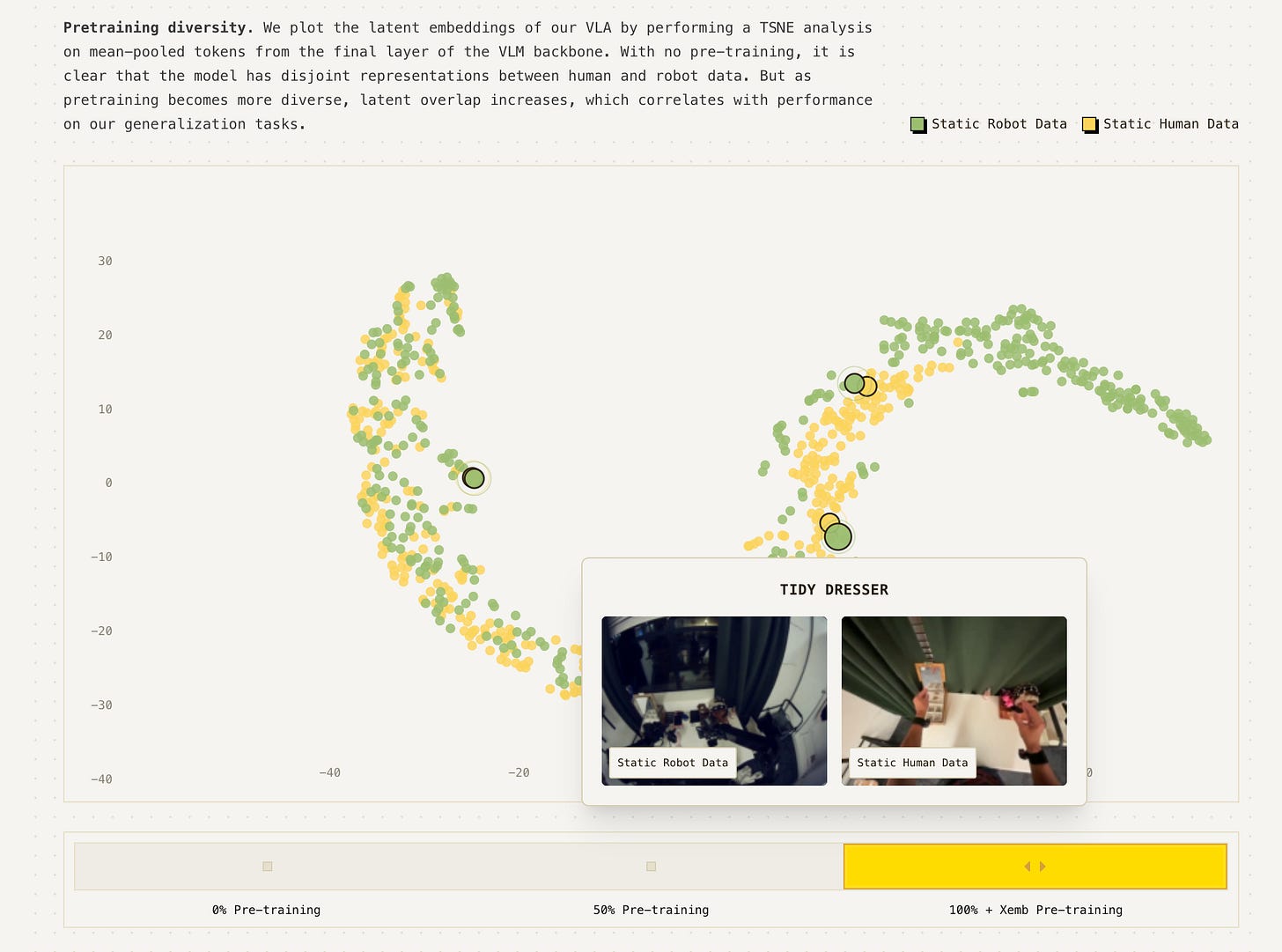
With more pretraining, the model stops distinguishing between human and robot data. Source: Physical Intelligence.
Simulation and world models
The other camp believes that simulation certainly is possible with the usage of world models.
World models have been getting a lot of attention recently, with companies like World Labs raising $1B in new funding.
As we know, traditional simulation and physics engines are fundamentally limited because they are an approximation of the real world. The idea is that world models are the bridge so that the physics is learned implicitly.
The most recent news is DreamDojo from NVIDIA. They pretrained a model on 44,000 hours of egocentric human video. Instead of building a physics engine from scratch, the model learns to “dream” what happens next given an action.
If world models get good enough, they could collapse the sim-to-real gap that Levine is skeptical about. This won’t happen by engineering better physics, but by learning it from data at scale. As Jim Fan says, this is Simulation 2.0
The Future
Foundational models for robotics are inevitable. The idea of humanoids walking around and being able to do most functions that humans can do is certainly dystopian (or utopian!), but I am certain that there is a future where this exists.
To be honest, I am not asking myself how do we get there, there seem to be many different viable paths and there will eventually be a thesis that comes out on top: deploying robots at scale for data collection, leveraging world models, or strapping on cameras onto humans.
What happens after we get there? Once the model is solved, the bottleneck shifts from data to everything else around it. What will manufacturing and supply chain look like? Software is easy to deploy, but hardware certainly isn’t. What will safety and ethics look like?
These are the questions I am thinking about, and I think it is more interesting than the “which thesis wins the data problem”.